by Stephen Soukup
There was nothing but land: not a country at all, but the material out of which countries are made.
—Willa Cather, My Ántonia, 1918.
The other day, I found myself facing two decisions. The first of these was whether I could take the time off work to drive four hours—two hours up and two hours back—for an event lasting less than twenty minutes. Given that the event in question was my son’s cross-country meet, it wasn’t a hard decision. He’s my youngest, after all, and in another blink of an eye, he’ll be done running high school meets and off doing something else, something I can’t take the afternoon off work to go watch, whether I want to or not. I’d have been a fool not to go.
Don’t worry, though. This isn’t going to be a long, maudlin, Cat’s-in-the-Cradle-esque dissertation on the importance of family and the ever-increasing speed with which time seems to pass. I’ve done that before, and I’ll probably do it again. But not today.
Instead, I want to focus on the second decision. After the race ended, and after I’d talked to my son, congratulated him on his race, and said my goodbyes to the other parents, I had to choose how I was going to drive home. Or rather, I had to choose the route I was going to take. By way of reference, I live in the vast expanses of flyover country, where the Midwest and the Great Plains butt up against one another. I drove to the meet on the interstate, which is convenient, slightly faster, and usually safer and less frustrating than the alternate routes. Few things in the world are more annoying and therefore potentially dangerous than pulling up behind a line of semis going 50 miles an hour up and down the rolling hills and around the gentle curves of a two-lane highway where the posted speed limit is 65.
Nevertheless, when faced with the choice between retracing the route I’d taken to get to the meet and taking the scenic route home on the two-lane highways, I picked the latter. I can’t say why I did so, exactly, but I can say that I am extremely glad I did and, in retrospect, I’m more than happy to have taken an additional 25 minutes to make the trip home.
Several years ago, when we still lived in DC, my wife and I flew home for the holidays and, while driving the hour-plus from the airport, had a conversation about a girl she knew in college. This girl—who was from one coast or the other—always complained about driving outside of the city. It felt unsafe, she said. The fact that there was “nowhere to hide” in the vast openness made her uneasy, as if she might, at any moment, have to dodge an alien invasion or a foreign air force. My wife and I both laughed. The literal forests lining the parkways in Northern Virginia and DC are pretty enough, we conceded, but we preferred the expanse of the plains, the ability to see clearly from horizon to horizon, the “big sky” that eastern Montana claims as its own but which describes much of the vast middle section of the country.
On those drives from the airport, often in the dead of winter, we would also discuss how beautiful the “colors” were and how everyone we knew in DC thought we were nuts. They could drive a couple of hours every fall to Skyline Drive in Shenandoah National Park and see all the glorious colors of nature—the reds, the oranges, the yellows, the greens, and even the purples of the trees as their leaves changed color and prepared to drop in advance of winter’s slumber. We, by contrast, were talking about brown and…well…just brown. That’s true, of course, but it’s not really “just” brown. It’s a thousand shades of brown, a veritable Pantone wheel running from light tan to red-brown rust to deep, dark chocolate, and hitting every hue in between. For two people who grew up where we did—and who missed it desperately—nothing in this world was more beautiful than brown.
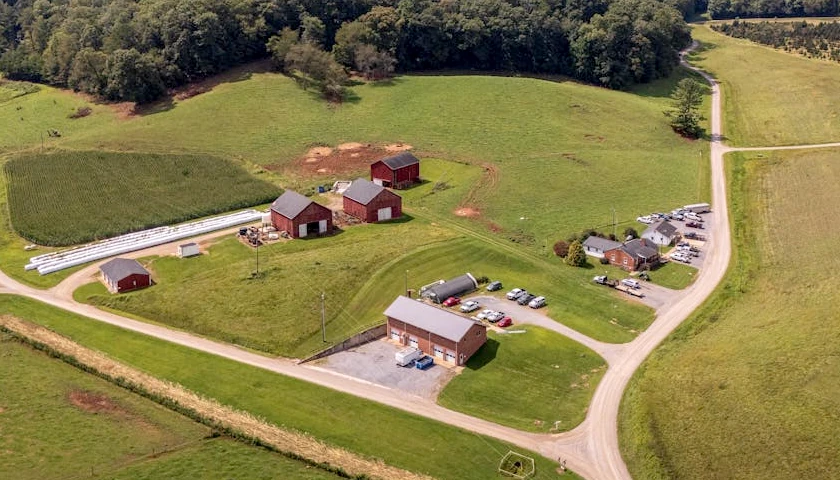
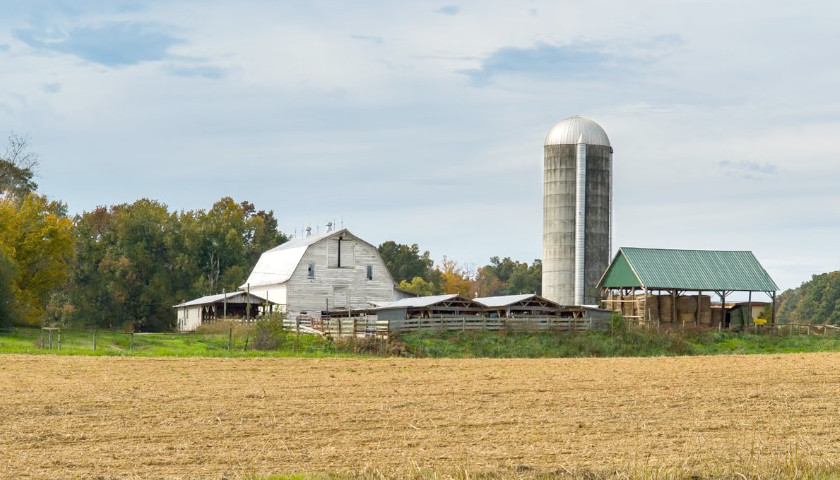
In any case, my drive home the other day didn’t really highlight the big sky much. The area through which I drove is close to one of North America’s great rivers, and so there are streams and trees and even rolling hills. At the same time, though, there was plenty of brown: the occasional small herd of Simmental, Gelbvieh, or Red Angus cattle; the massive fields of dried but still unharvested soybeans; and the unending acres upon acres of field corn stalks, drying down after an unusually wet September. Even as I drove due west on an abnormally hot and bright early October evening, my eyes were shielded from the sharpest rays by the light brown dust haze that typically blankets the sun on country roads during the harvest.
As I say, I am glad I chose to take the long way home. It was calming. It was beautiful. It was relaxing, even—or, perhaps, especially—during those parts of the drive I made in silence because the cell signal cut out and I was left with no Spotify. At the same time, though, the drive was a little aggravating. In our perpetually politicized world, even an otherwise peaceful drive in the country reminds one of the hypocrisies of our ruling class and their ongoing efforts to ruin every aspect of our lives by injecting ideology and partisanship into them. Nothing is safe from the reach of our intellectual and moral betters who can’t help but insist that we pay them the deference they demand but have hardly earned.
I was reminded of the most glaring of these hypocrisies by something as seemingly innocuous as the small, unobtrusive signs that sit next to the roads alongside every field. Many people think that these signs signify which corporation or conglomerate owns the field next to which they sit. That’s not the case, though. The signs are really advertisements, placed near the field by the family farmer who owns it, in conjunction with his seed rep. The signs identify the hybrid corn or GMO soybean seed grown in that field. As such, they also represent the resourcefulness and ingenuity of American agriculture.
When people in politics think about the most fitting and accurate retort offered to the ridiculous predictions made more than a half-century ago by the doomer-biologist Paul Ehrlich, they usually think of Julian Simon. Ehrlich wrote The Population Bomb in 1968 and predicted that the world would run out of food in the next couple of decades and that hundreds of millions of people would starve to death as a result. Ehrlich was, of course, spectacularly wrong, but his “population panic” nonsense lent scientific cover to the millions of abortions and forced sterilizations in China and India in the 1970s and ‘80s. Simon, an economist at the University of Illinois, believed that human ingenuity, innovation, markets, and substitution effects would make resources more abundant over time and argued that the doomers were wrong. In 1980, Simon and Ehrlich made a bet on the price of five metals, chosen by Ehrlich, that he and his fellow Malthusians thought would be scarcer and more expensive a decade later because of over-mining and population growth. Despite the largest absolute population growth in world history (to that point), Simon proved right, and Ehrlich was humiliated—or at least he should have been. Ever since, Julian Simon has been cited as the natural refutation of Ehrlich-ian enviro-pessimism.
For my money, however, the best response to Ehrlich came not from Simon, but from Norman Borlaug, a farm boy from Cresco, Iowa. Borlaug earned a BS in forestry and a PhD in plant pathology and genetics from the University of Minnesota. After working for DuPont during World War II, Borlaug joined the Rockefeller Foundation’s Cooperative Wheat Research and Production Program in Mexico in 1944, where he became a pioneer in the science of plant breeding. Borlaug’s work not only contributed to massive increases in wheat production in Mexico, Pakistan, and India, thereby easing or staving off expected famines, but it also helped lay the scientific foundations for modern seed optimization, which today enables American farmers to feed the world. Borlaug and fellow Iowan Henry A. Wallace (the godfather of commercial seed hybridization) were responsible for changing the world—and are also responsible for those little seed-sign advertisements on the side of rural roads. While Paul Ehrlich lost a foolish wager with Julian Simon and contributed to the destruction of countless potential lives, Norman Borlaug won the Nobel Peace Prize in 1970 and saved millions from agonizing death by starvation.
Of course, the environmental Left generally lionized Ehrlich, despite his destructive inaccuracies, while it continues to fuss and fret at the farmers who have harnessed Borlaug’s brilliance and feed billions worldwide. They object to “GMOs” and “frankenfoods,” insisting that organic, non-GMO farming is the only “safe” farming. Likewise, they object to fossil fuel use by farmers and their allegedly environmentally devastating practice of raising cattle. The ESG restrictions placed on American farmers or threatened against them are both prohibitive and self-defeating. On the one hand, they insist that the world has too many people doing too much damage to the environment, while on the other hand, they try to stop the science-driven practices that proved Paul Ehrlich wrong, that feed the masses, and that enable the long-term, inflation-adjusted decline in most commodity prices.
The second hypocrisy—which deserves its own column, and to which I will therefore likely return—is the ongoing hatred of those who profess to want to “save democracy” for the actual “demos.” The American ruling class wants desperately to paint Donald Trump and his fellow non-traditional Republicans as threats to democracy and to the American way of life. At the same time, though, they really can’t stand the people whose votes they profess to want. This is especially true of the wannabe-populists. They profess to represent “the people,” when in truth, they have nothing but contempt for the people in my part of the country.
A few weeks ago, Dan Osborn—a Democrat-endorsed independent candidate for the Senate seat in Nebraska—was caught on tape saying exactly what he and his fellow wannabe-populists think about their fellow countrymen, Osborn’s fellow Nebraskans, those farmers who feed the world:
Billy Bob in f—ing Red Cloud, Nebraska, who lives next door to the f—ing Trump store as you pull into town and is waving the Trump flag … all he knows is he’s like on the winning team. It’s really that simple. … [Trump has] been so effective at taking Billy Bob and his wife Mary Jane or Mary Jo and telling them, ‘Look, we’re winning. You’re on the winning team.’ And that’s all they care about because their lives probably suck so f—ing bad.
I don’t know, Dan. I wasn’t driving through Red Cloud last week, but I drove through places that are not much different—other than not being the home of Willa Cather. I don’t think those people hate their lives. Or at least most of them don’t. And they deserve to be represented by a ruling class that doesn’t hate them either. The oikophobia on display by Osborn here is, unfortunately, endemic among our “rulers” today. They don’t understand the importance of the prairies, of the farmers, of the pioneers who till the ground. That’s their loss—but it’s the nation’s loss as well.
– – –
Stephen R. Soukup is the Director of The Political Forum Institute and the author of The Dictatorship of Woke Capital (Encounter, 2021, 2023).